

Quick answer: To write a professional CV in 2026, focus on 6 elements: clear contact details, a strong 3-line professional summary, experience framed as measurable achievements (not duties), skills matched to the job, concise education, and clean ATS-friendly formatting. The golden rule: design your CV to pass the automated filter first, then convince the recruiter — and use keywords straight from the job posting.
Introduction: Why Your CV Is Your First Gateway
In today's job market, a CV is no longer just a page where you list your details and call it done. Your CV is your first voice in front of an employer — it speaks on your behalf before you ever sit in the interview chair. In just a few seconds, a recruiter decides whether to keep reading your file or move on to the next candidate.
That's why the way you write your CV can be the real difference between landing an opportunity and losing it without ever knowing why. Whether you're a fresh graduate chasing your first job or a seasoned professional aiming for a bigger career move, a carefully written CV measurably multiplies your chances.
In this practical guide, we'll take you step by step to learn how to write a strong CV that passes applicant tracking systems and leaves a professional impression that sticks in the reader's mind.
What Does an Employer Look For in Your CV?
Before you start writing, it helps to understand the mindset on the other side. A recruiter doesn't read your CV word by word at first — they scan it in seconds, hunting for specific signals:
Job relevance: Do your experience and skills match what the posting asks for?
Achievements, not duties: What did you actually accomplish, not just what was expected of you?
Clarity and structure: Can they find what they need quickly?
Professionalism: Is the CV error-free and neatly formatted?
When you write with these points in mind, you design your CV to answer the employer's questions before they're even asked.
The Essential Elements of a Professional CV
A strong CV is built from clear sections, each with a defined role. Here are the elements you can't do without:
1. Contact Information
Place it clearly at the top: full name, phone number, a professional email, and your LinkedIn link if you have one. Avoid informal email addresses and make sure every detail is current and correct.
2. Professional Summary
This is the first thing the eye lands on after your name — the most important 3 lines of your CV. Summarize who you are professionally, highlight your experience, and state what you bring. Tailor it to each job you apply for, rather than reusing one generic paragraph everywhere.
3. Work Experience
This is the heart of your CV. List your experience from most recent to oldest, and for each role include: title, organization, dates, then your key achievements. Most importantly: write achievements with numbers, not generic duties.
4. Skills
Split them into technical skills (related to your field) and soft skills (communication, leadership, problem-solving). Choose the skills the posting specifically requests — this boosts your chances of passing the automated filter.
5. Education and Certifications
List your highest qualification first: degree, major, university, graduation year. Add any relevant professional certifications or accredited courses tied to the job.
The Art of Writing Achievements With Numbers
This is the point that separates an ordinary CV from an exceptional one. Most people write duties, while professionals write measurable achievements.
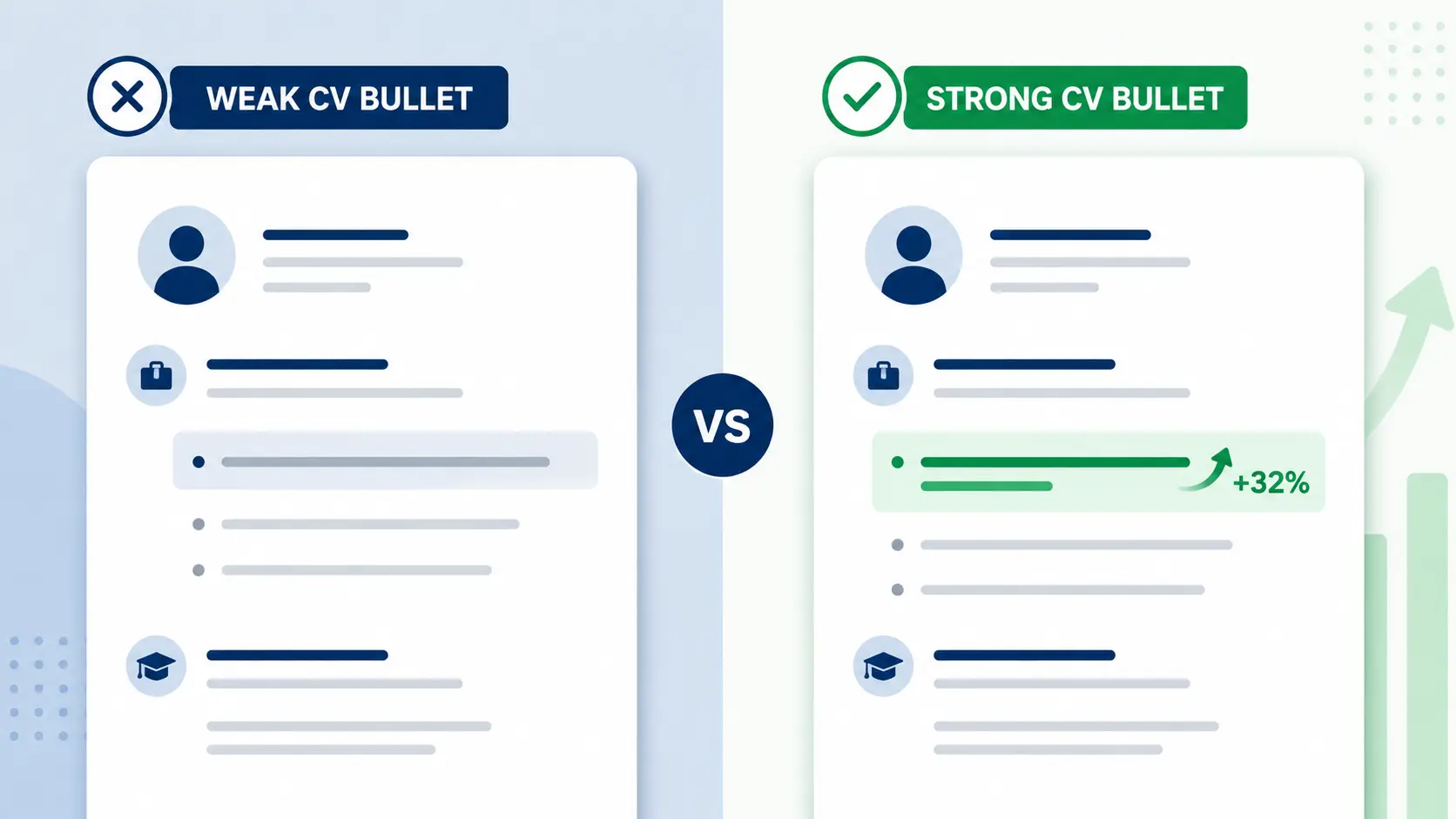
Compare the two styles:
Weak phrasing (duty) | Strong phrasing (achievement) |
|---|---|
Responsible for managing social accounts | Grew platform followers by 40% in 6 months |
Worked on improving sales | Raised monthly sales by 25% via a new marketing plan |
Helped customers and solved issues | Cut customer complaints by 30% in one quarter |
Notice how the strong phrasing answers "and what was the result?". The more you turn duties into numbers and outcomes, the stronger your CV becomes.
How to Make Your CV Pass Applicant Tracking Systems (ATS)
Most large companies today, especially in the Saudi market, use Applicant Tracking Systems (ATS) to filter CVs automatically before any human sees them. If you don't design your CV for these systems, it may be rejected before anyone reads it.
To pass the automated filter:
Use keywords from the job posting: if it asks for "project management," use that exact term, not a synonym.
Avoid complex designs: nested tables, images, and multiple columns can confuse the system.
Use standard section headings: "Work Experience," "Education," "Skills" — not quirky creative titles.
Save the file in the right format: usually PDF or Word, depending on the posting.
Don't put key information in the header or footer: some systems don't read them.
The golden rule: design your CV to pass the system first, then to impress the human second.
Common Mistakes That Sink Your CV
Even with good content, small mistakes can hold you back:
A CV that's too long: one page is enough for graduates, two pages maximum for experienced professionals.
Spelling and grammar errors: they signal carelessness. Proofread more than once.
Generic, untailored text: sending the same CV to every job sharply lowers your odds.
Too much personal information: no need for details unrelated to the job.
Missing achievements: simply listing duties with no results.
A Ready CV Template 2026
Here's a simple structure you can build on right away:
[Full Name]
[Job Title] | [City] | [Phone] | [Email] | [LinkedIn]
Professional Summary
[3 lines summarizing your experience, specialty, and top value]
Work Experience
[Title] — [Organization] | [Dates]
[Achievement with numbers]
[Achievement with numbers]
Skills
[Technical skill] · [Technical skill] · [Soft skill] · [Soft skill]
Education
[Degree] — [Major] | [University] | [Graduation year]
Certifications
[Certification] — [Issuer] | [Year]
You can adapt this template to your field and experience level. What matters most is keeping it clean, clear, and easy to read for both the system and the human.

Final Tips for a CV That Leaves a Mark
Tailor your CV to each job: adjust the summary and skills to match each posting.
Start sentences with strong verbs: "Developed," "Led," "Achieved," "Launched."
Keep formatting consistent: one font, even spacing, clean alignment.
Get outside feedback: a second pair of eyes catches errors you might miss.
Update it regularly: don't wait until you're job-hunting to refresh your CV.
For examples and global standards on CV writing, you can refer to trusted resources such as Harvard's résumé guide.
Conclusion
Your CV isn't just a summary of your past — it's a marketing tool for your professional future. When you write it clearly, frame your experience as measurable achievements, and design it to pass tracking systems, you give yourself the best shot at reaching the interview stage.
Start today by reviewing your current CV against what you've learned here, and you'll notice the difference in employer responses. Remember: one strong, tailored CV beats ten generic, repeated ones.
Frequently Asked Questions About CV Writing
What is the ideal CV length?
One page is enough for fresh graduates and those with limited experience; two pages maximum for people with long years of experience. What matters most is focusing on job-relevant information rather than filling pages.
How do I make my CV pass ATS systems?
Use keywords from the job posting itself, avoid complex designs and nested tables, use standard section headings, and save the file in the required format. Don't place important information in the header or footer.
Should I write one CV for all jobs?
No — it's best to tailor your CV to each job by adjusting the professional summary and skills to match each posting's requirements. A tailored CV significantly raises acceptance chances compared to a repeated generic version.
What's the difference between duties and achievements on a CV?
Duties describe what was expected of you (e.g., responsible for sales), while achievements describe what you actually delivered with numbers (e.g., raised sales by 25%). Numerical achievements are far stronger and leave a deeper impression.
Your Practical Step Now
Don't delay. Today only:
Open your current CV and turn 3 duties into numbered achievements, or
Rewrite your professional summary into 3 lines tailored to the job you want.
A small start today beats the perfect CV you never write.