

Quick answer: To boost workplace productivity and get more done in less time: prioritize your tasks, focus on one task at a time, eliminate distractions, use techniques like time blocking and the two-minute rule, and take regular breaks. The golden rule: productivity isn't about working longer hours, but working smart on what truly matters — completing 3 important tasks beats being busy all day with trivial ones.
Introduction: Why Doesn't Being Busy Mean Being Productive?
Many people spend their day busy all the time, moving from task to task without stopping, then feel at the end of the day that they didn't accomplish anything truly important. This paradox reveals a fundamental truth: being busy isn't productivity.
Real productivity isn't in the quantity of what you do, but in the value of what you accomplish. A productive employee isn't the one who works more, but the one who achieves greater results with smarter effort. In a world full of distractions and crowded tasks, the ability to focus on what matters has become a rare and valuable skill.
In this guide, you'll learn practical strategies to boost your productivity and get more done in less time, without exhaustion. And productivity is a core skill in any successful career development plan, because it determines your real value at work.
Rule 1: Prioritize Your Tasks
Not all tasks are equal in importance. The biggest mistake is treating all your tasks with the same priority, wasting your energy on the trivial and postponing the important.
To prioritize wisely:
Distinguish between important and urgent; not everything urgent is important.
Start with the most important task when your energy is at its peak.
Identify the 3 most important tasks daily and do them first.
Postpone or delete low-value tasks.
When you focus your energy on what achieves the greatest impact, you get more done with less effort. This is the essence of productivity.
Rule 2: Focus on One Task
The belief that multitasking increases productivity is a myth. The brain doesn't perform two tasks with real focus at once — it switches between them, losing time and quality with every switch.
For effective single-tasking:
Complete one task before moving to the next.
Close notifications while working on an important task.
Dedicate deep-focus periods without interruptions.
Resist the temptation to constantly switch between tasks.
Focusing on one thing at a time raises the quality and speed of your work together, contrary to what many think.
Rule 3: Eliminate Distractions
Distractions are the number one enemy of productivity. Every interruption costs you not just its time, but the extra time your brain needs to return to focus.
To reduce distractions:
Turn off phone and app notifications while working.
Dedicate specific times for email and messages instead of constant instant replies.
Set up a quiet work environment as much as possible.
Use a "no interruption" rule during focus periods.
The fewer the distractions, the deeper your focus and the faster your completion. Protecting your focus is a direct investment in your productivity.
Rule 4: Use Productivity Techniques
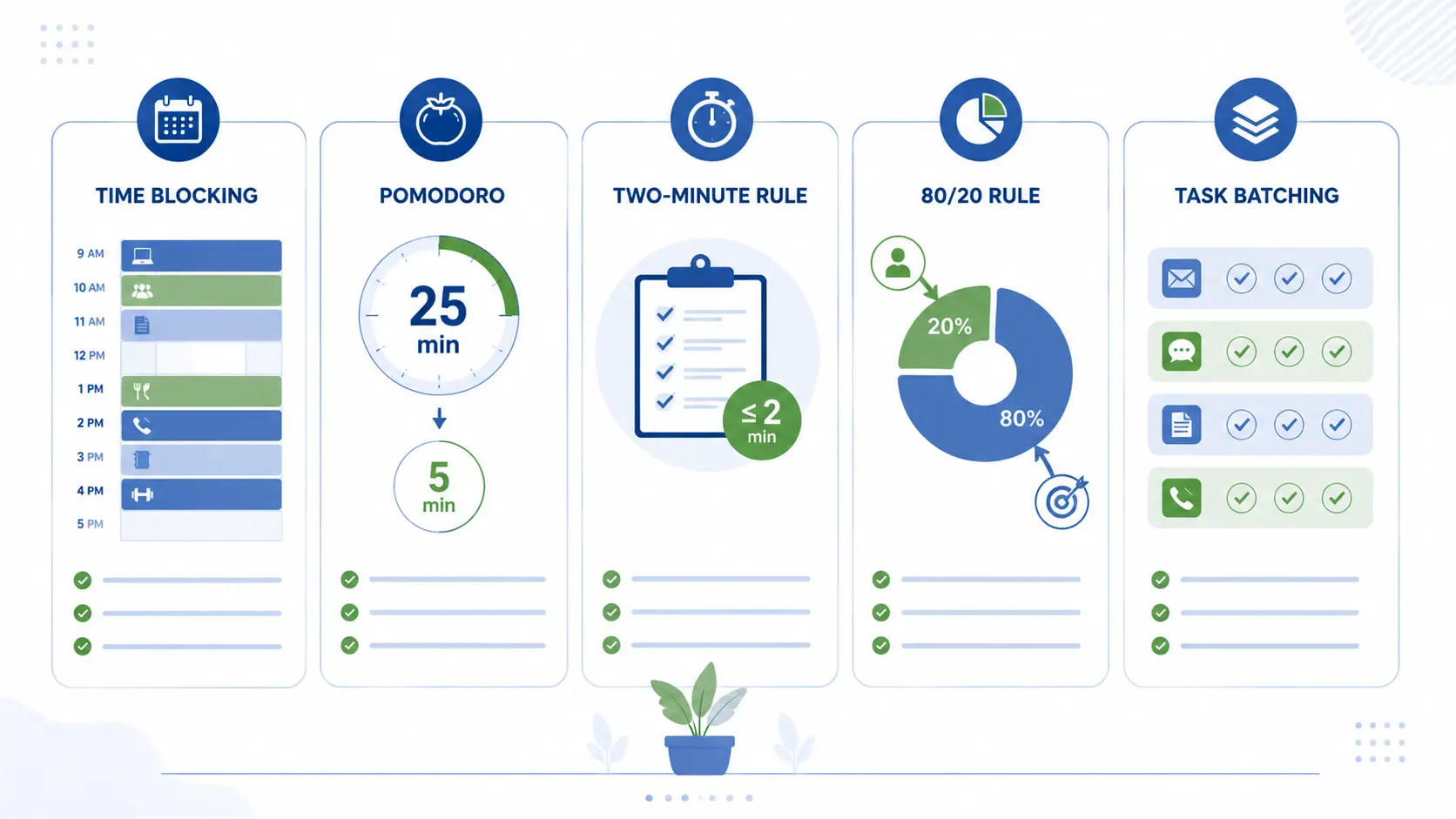
Organized techniques turn good intentions into actual results. Among the most effective:
The two-minute rule: if a task takes less than two minutes, do it immediately instead of postponing it.
Time blocking: dedicate specific periods to each type of task.
The Pomodoro technique: 25 minutes of focus, 5 rest, and repeat.
Batching similar tasks: do them together to save switching energy.
The 80/20 rule: focus on the 20% of tasks that achieve 80% of results.
Try these techniques and choose what suits your style, as the right tool makes a big difference in your productivity.
Rule 5: Plan Your Day in Advance
Entering your day without a plan means leaving it to randomness and reactions. Minutes of planning save hours of execution.
For effective planning:
Plan your day the previous evening or first thing in the morning.
Write your tasks instead of relying on your memory.
Set estimated times for each task.
Review your plan and adjust it according to priorities.
A planned day gives you clarity and control, so you start with a goal instead of drifting with what comes up.
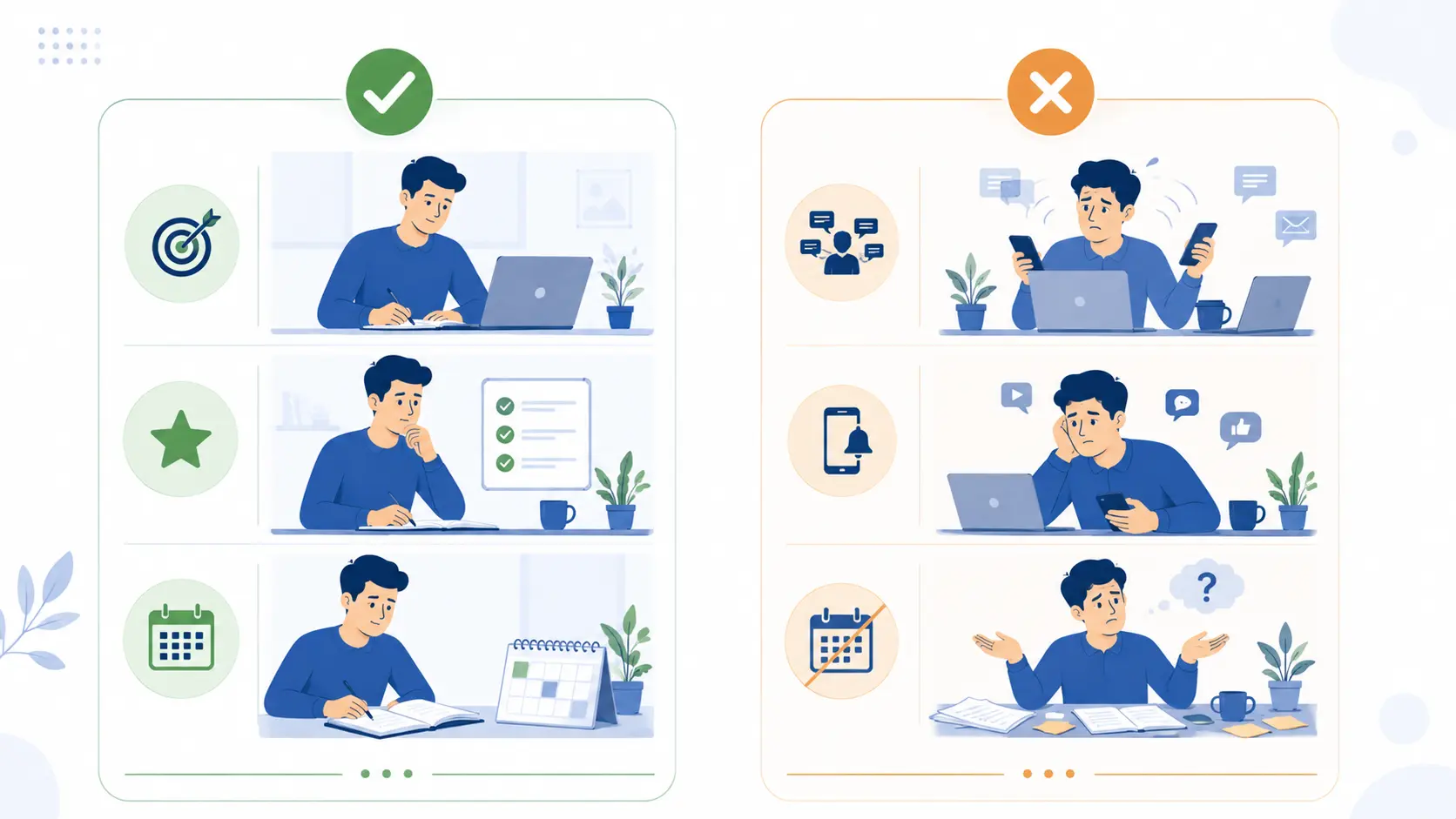
Table: Habits That Boost Productivity vs. Habits That Reduce It
Productive habits | Draining habits |
|---|---|
Focusing on one task | Scattered multitasking |
Prioritizing | Treating all tasks equally |
Deep-focus periods | Constant interruptions |
Regular breaks | Working non-stop until exhaustion |
Advance planning | Randomness and reactions |
Awareness of the difference between the two habits is the first step toward higher productivity and longer sustainability.
The Role of Rest in Productivity
It may seem contradictory, but rest is a core part of productivity. An exhausted brain works slowly and makes more mistakes, while a rested brain focuses and creates.
For productive rest:
Take regular short breaks throughout the day.
Get enough sleep, as it's the foundation of focus.
Disconnect completely after work to recover your energy.
Do a physical activity that activates your mind.
Sustainable productivity comes from balance, not from draining your energy until exhaustion. As we explained in time management and avoiding burnout.
Common Mistakes That Kill Productivity
Multitasking thinking it saves time.
Starting with easy tasks and postponing the important one.
Responding instantly to every notification and message.
Absence of planning and working randomly.
Neglecting rest until reaching exhaustion.
Excessive perfectionism that hinders completion.
Avoiding these mistakes frees your energy and doubles your output without extra work hours.
For additional professional productivity strategies, you can refer to trusted resources such as Indeed's productivity guide.
Conclusion
Real productivity isn't in working longer hours or being constantly busy, but in working smart on what truly matters. When you prioritize your tasks, focus on one task, eliminate distractions, and use the right techniques, you get more done with less effort and less stress.
Start today by applying one rule from this guide, and notice the difference. Remember: completing 3 important tasks daily beats being busy all day with no result. Productivity is a skill built through habits, so build it step by step to make a difference in your path and life.
Frequently Asked Questions About Workplace Productivity
How do I increase my productivity at work?
Prioritize your tasks, focus on one task at a time, eliminate distractions, use techniques like time blocking and Pomodoro, and plan your day in advance. Productivity is in working smart on what matters, not in working longer hours.
Does multitasking increase productivity?
No, multitasking is a myth that reduces productivity. The brain doesn't perform two tasks with real focus together — it switches between them, losing time and quality with each switch. Focusing on one task at a time is faster and higher quality.
What's the best technique to boost productivity?
Among the best: time blocking, the Pomodoro technique, the two-minute rule, and the 80/20 rule. There's no single technique that suits everyone, so try more than one and choose what fits your work's nature and your style.
Does working longer hours mean higher productivity?
No, the opposite is often true. Working non-stop leads to exhaustion, declining performance, and more mistakes. Real productivity is in working smart and taking breaks, so completing what's important in less time beats long busyness with no result.
Your Practical Step Now
Don't delay. Today only:
Identify your day's 3 most important tasks and do the most important first, or
Turn off all notifications and try a 25-minute deep-focus period on one task.
A small start today beats the perfect productivity that never comes.