

Quick answer: To manage your time and avoid burnout in remote work: set a consistent daily routine, define clear work hours and regular breaks, separate your workspace from your personal life, use time-management techniques like the Pomodoro technique, and learn to say "no" to extra tasks. The golden rule: remote work dissolves the boundaries between work and life, so the boundaries you set yourself are your only shield against burnout — sustainable productivity comes from balance, not from working non-stop.
Introduction: Why Does Remote Work Cause Hidden Burnout?
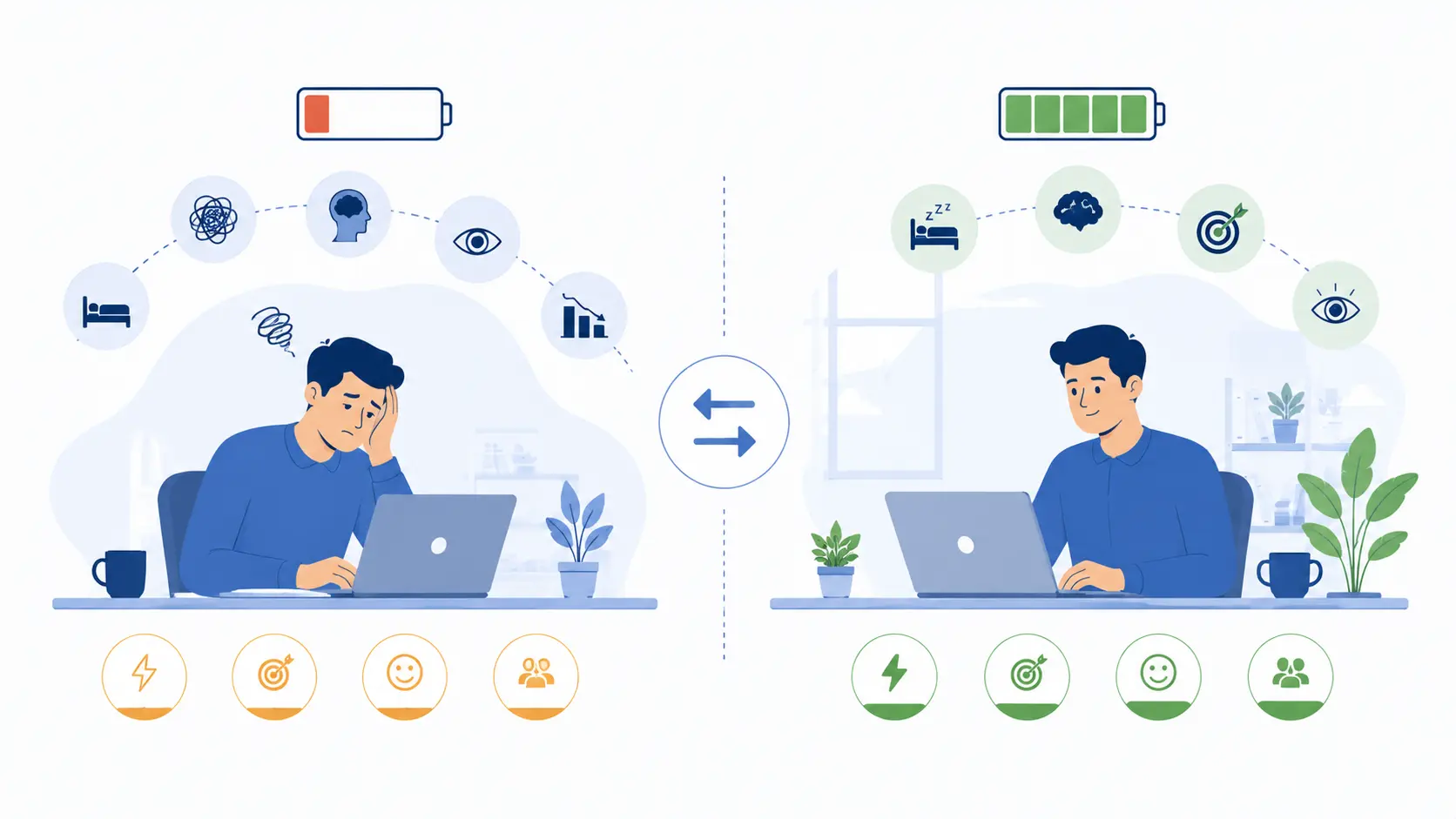
Remote work seems at first glance like a dream: no commute, flexibility, and the comfort of home. But behind these advantages lies a serious, often overlooked challenge: burnout. When the dividing line between the office and home disappears, many tend to work longer hours unconsciously, until they reach the edge of professional burnout.
The irony is that remote work, despite its flexibility, can be more exhausting than office work if you don't manage it wisely. The absence of routine, home distractions, and the difficulty of "shutting down" work all gradually drain your energy.
In this guide, you'll learn how to manage your time and protect your energy in remote work, to achieve sustainable productivity without paying the price with your mental health. This guide complements remote work tools and skills with the most important aspect: maintaining your balance.
Step 1: Set a Consistent Daily Routine
Routine is the most powerful weapon against the chaos of remote work. In the office, the place and colleagues impose a natural rhythm, but at home you have to create this rhythm yourself.
To build an effective routine:
Wake up at a fixed time as if going to the office.
Start work at the same hour daily.
Prepare yourself for work (wear appropriate clothes, don't work in pajamas).
Set a fixed time to end work and commit to it.
A consistent routine programs your mind for focus and rest times, making your productivity more automatic.
Step 2: Define Clear Work Hours
The biggest trap in remote work is the absence of a clear end to the workday. When there's no time to leave, work stretches to swallow your evening and weekend.
To define your hours:
Set a clear start and end to your workday.
Inform your team of your availability hours to avoid unrealistic expectations.
Close work tools after working hours.
Resist the temptation of "one last task" that never ends.
Clear work hours protect your personal time and give you real mental rest after work.
Step 3: Separate Your Workspace From Your Life
When the workplace overlaps with the rest place, it becomes hard for your mind to switch between "work mode" and "rest mode." This overlap is one of the biggest causes of burnout.
For effective separation:
Dedicate a corner or room for work that you don't use for rest.
Avoid working in bed or on the couch.
"Leave" your office mentally after work ends.
Practice a ritual that separates work and rest (a short walk, changing clothes).
Physical and mental separation helps your mind truly relax after the workday.
Step 4: Use Time-Management Techniques
Organized techniques turn your day from chaos into productive flow. Among the most famous and effective:
The Pomodoro technique: work with focus for 25 minutes then rest 5 minutes, and repeat. It maintains your focus and prevents burnout.
Batching similar tasks: do similar tasks together to save switching energy.
The top 3 tasks rule: identify the 3 most important tasks daily and do them first.
Time blocking: dedicate specific periods to each type of task.
Try these techniques and choose what suits your nature, as the right tool doubles your productivity without exhaustion. And time management is a core skill we explained in workplace productivity.

Step 5: Take Regular Breaks
Working non-stop may seem more productive, but the opposite is true. The brain needs rest periods to maintain its focus and energy.
For effective breaks:
Take regular short breaks throughout the day.
Step away from the screen during the break (look far, move).
Take a real lunch break away from your desk.
Move physically to activate your blood circulation and mind.
Breaks aren't a waste of time, but an investment in your focus and energy over the long term.
Signs of Burnout to Watch For
Awareness of early burnout signs helps you intervene before reaching professional burnout. Watch for these indicators:
Continuous exhaustion even after rest.
Difficulty focusing and declining productivity.
Loss of enthusiasm for work you used to love.
Increasing stress or irritability.
Neglecting personal life and relationships.
If you notice these signs, they're a signal to stop and rebalance before they worsen.
How Do You Protect Your Mental Health in Remote Work?
Isolation is one of the biggest challenges of remote work, and it directly affects your mental health. To protect it:
Maintain social contact with colleagues and friends.
Leave the house daily even for a short period.
Exercise regularly as it improves mood and energy.
Disconnect completely on your weekend without checking work.
Ask for support if you feel continuous pressure.
Your mental health is the foundation of your productivity and sustainability in remote work, so never neglect it.
Common Mistakes That Lead to Burnout
Working without clear time boundaries.
Skipping breaks thinking they waste time.
Accepting all tasks without the ability to say "no."
Working from bed or rest areas.
Neglecting social contact and isolating.
Constantly checking work even outside working hours.
Avoiding these mistakes protects your energy and makes your remote work sustainable rather than exhausting.
For additional professional tips on work-life balance, you can refer to trusted resources such as Indeed's work-life balance guide.
Conclusion
Remote work is a blessing that requires conscious management to remain a blessing. Without clear boundaries, a consistent routine, and regular breaks, its flexibility can turn into a source of burnout that drains your health and productivity.
Start today by setting clear boundaries for your workday, a routine you commit to, and breaks you don't skip. Remember: real productivity isn't in working non-stop, but in the balance that preserves your energy and passion over the long term. Take care of yourself, because you're your most valuable asset.
Frequently Asked Questions About Time Management in Remote Work
How do I manage my time in remote work?
Set a consistent daily routine, define clear work hours with a start and end, use time-management techniques like Pomodoro and time blocking, and identify the 3 most important tasks daily. A consistent routine and clear boundaries are the foundation of effective remote organization.
How do I avoid burnout in remote work?
Define clear work hours and close work tools afterward, separate your workspace from your life, take regular breaks, learn to say "no" to extra tasks, and maintain your mental health and social contact. Balance is the key to avoiding burnout.
What are the signs of burnout in remote work?
The most prominent are: continuous exhaustion even after rest, difficulty focusing, loss of enthusiasm for work, increasing stress, and neglecting personal life. If you notice these signs, stop and rebalance before reaching professional burnout.
Do breaks reduce productivity?
No, they increase it. The brain needs rest periods to maintain its focus and energy. Working non-stop leads to exhaustion and declining performance, while regular breaks are an investment in your focus and sustainable productivity over the long term.
Your Practical Step Now
Don't delay. Today only:
Set a fixed hour to end your work today and actually commit to it, or
Try the Pomodoro technique on one task (25 minutes work, 5 rest).
A small start today beats the perfect balance that never comes.